
Step Up
“Don’t step on yourself to step over yourself. What you are and where you are, that’s enough for whatever is next. Paradoxically, you have to try harder to try less hard, to take it easier in the quest to work at your best level.”
I wrote those words on Halloween 2020. They could have served as an epigraph to my chapter W = Words, about the potential harms and benefits of self talk. Instead, I used some beautiful words from Edward De Bono for a somewhat different take:
“In a sense, words are encyclopedias of ignorance because they freeze perceptions at one moment in history and then insist we continue to use these frozen perceptions when we should be doing better.”
By better let’s say instead more intentional, the quality you desire...whatever that may be.
Hiding the Scissors
One of the core elements of The Insomniac's Guide to Productivity is Awareness.
Not the Instagrammable kind. Nor the serene, lotus-position kind.
I mean the gritty, inconvenient, how-did-I-do-that-to-myself kind.
There is a form of self-awareness that functions like a diagnostic tool. It doesn’t flatter us. It doesn’t inspire us. It simply reveals where we are quietly, unconsciously working against ourselves.
And if we’re willing to look at it, it can change everything.
The Curious Case of the Missing Scissors
The other day I needed scissors to open a package. A simple task. I searched everywhere. Finally, I found them — beneath the very package I was trying to open.
How does that happen?
Either I momentarily lost 75 IQ points or...I did it on purpose.
The first explanation is the comfort of a joke. The second is unsettling. Because if I did it “on purpose,” I did it without conscious intention — but not without agency. Somewhere between awareness and non-awareness, an action occurred that worked directly against my own goal.
Going Retrograde
What is a potential word for this tendency?
“Self-sabotage” is a well-known idea, but a touch dramatic.
“Carelessness” is too mild.
“Forgetfulness” is too dismissive.
I’m pointing toward something more subtle: a self-retrograde movement — an action that works against my own best interest, not because I’m incapable, but because some part is misaligned.
I hide the scissors from myself.
I put the phone on silent and then complain that I missed the call.
I stay up late scrolling and then lament my exhaustion.
The action feels almost fated — as if someone with inside knowledge of my goals is rearranging the furniture of just enough to trip me up. And there is such a someone: me. (The insomniac.)
The Subliminal Swamp
Psychologists have long observed that people can register events without consciously recalling them. A witness to a crime might “see” something without being able to access it directly. The information is there — but buried in a swamp of random access.
Similarly, our own counterproductive behaviors often originate from information we haven’t excavated:
- Avoidance of discomfort
- Fear of finishing
- Fear of beginning
- A quiet resistance to change
- A learned pattern of tension
The mind acts. The conscious self arrives later and says, “How did this happen?” You put the package on top of the scissors.
Insomnia and the Self-Defeating Loop
For those of us prone to insomnia (and productivity anxiety), this pattern becomes especially visible.
- We say we want rest. (But gotta check just one more email.)
- We say we want focus. (But we look up one fact and end up with seventeen new browser tabs.)
- We say we want clarity. (But refuse to accept a reasonable answer.)
These are tacit micro-choices. Micro-choices that accumulate and further burden (un)awareness.
Awareness Is The Magnifying Glass
Try this shift:
Instead of condemning yourself when you discover the scissors under the package, treat the moment as data. The discovery isn’t proof of inadequacy. It’s evidence of a split in attention. That split is your clue.
The goal isn’t to eliminate every self-retrograde move. The goal is simply to shorten the time between action and recognition. If you notice it five minutes later instead of five days later, that’s progress. And if you come to recognize it while it’s in progress…that’s mastery.
The Productive Reframe
The Insomniac’s Hexagon begins with Awareness for a reason.
Without awareness:
- Structure becomes rigidity.
- Prioritization becomes diffuse (or worse, fantasy).
- Habitat becomes clutter.
But with awareness, even self-defeating patterns can become tools. That moment you catch yourself placing the package on top of the scissors, you are no longer unconscious. You are observing. And observation introduces the potential of choice.
A Small Exercise
Take a moment and think of an example where you worked against yourself.
Don’t judge it. Don’t dramatize it. Just ask:
- What was I avoiding?
- What was I protecting?
- What discomfort did I sidestep?
To see the pattern is to loosen its grip. It may be smaller than you imagined and awareness was sufficient to see it dissolve. But even when it remains, the balance has shifted — you are directing the movement now, not being carried by it.
To Your Best Days
Productivity is not about optimizing every minute. But let’s allow for reducing unnecessary self-suffering. We all hide the scissors from ourselves from time to time. The work is not to become flawless. The work is to become aware. And from awareness — gently, steadily — to act in your own favor.
Simple Is Your Superpower
(One of them.)
Everybody has distractions. Competing priorities. Emails. News. Family needs. The low-grade hum of unfinished tasks.
But the insomniac carries something extra.
Alongside the normal noise of life, we contend with low energy, low concentration, low motivation. They may not seem like dramatic obstacles to ordinary folk, but they’re subtle pings. They bunch up. They circle. You sit down to work and suddenly you’re in a task-loop with no exit:
I should do this. But what about that? Maybe start over there. No, this is more important. To hell with it—let’s just juggle everything. And nothing meaningful moves.
The answer is simple. Literally simple.
Simplicity is one of the foundational paths of The Insomniac’s Hexagon. It’s easy to forget that while we don’t always control our sleep, we often do control the level of complication we allow into a moment. We can choose to simplify—if only briefly—the direction of focus.
In many ways, every tool in The Insomniac’s Guide to Productivity is about this choice. It’s about building the ability to settle down and settle in.
When the agenda is packed, progress feels impossible because there’s no single lane. So create one.
Take a breath. Then take a minute.
Yes, a minute. Unless you’re James Bond and the nuclear device is ticking down to zero, you have sixty seconds to give yourself. You can do a minute.
Do nothing. The kind of nothing that pays dividends.
Close your eyes. Breathe. Let the spinning list go. Let the kaleidoscope of responsibility settle to a blank field. If this sounds like meditation, that’s because it is—but don’t worry about the label. Just step out of the circle.
When the mental noise softens, something interesting happens: clarity returns. Not all at once. Not in a blast of revelation. But enough to see one meaningful next step.
Simple is your superpower.
When energy is low, complexity drains you. Simplicity restores you.
Choose one thing. Do it. Then choose again.
That’s how insomniacs move forward.
Crazy Good Aging
I'm appearing today (February 5, 2026) on the podcast Crazy Good Aging, with Dorothy Shore and Valerie Freeman, co-founders of Prime Women Media, to talk about what it's like to be "wide awake at 3 a.m. and how to be productive when sleep is elusive."
While the show is being taped today, I'm not sure yet when it will air, but I will update this post with a link when I have it.
Break the Pattern
A key element of The Insomniac’s Hexagon — indeed, its foundational element in many ways — is Awareness. When I speak of a pattern, and the possibility of “breaking” it, this connotes a negative or non-beneficial regularity that ends up costing more than it’s worth, at best, and possibly more than we can afford, at worst.
What kinds of pattern? In my case, I often deal with patterns of body tension that arise from mental strain: automatic responses to situations, experiences, even words or phrases, that trigger some reaction that isn’t in my best interest. But when the pattern plays out, automatically and quickly, it’s too late to do anything but try and stop the flow of energy that’s causing the tension. That’s if I’m fortunate. And aware. Otherwise I might suddenly wonder why my back is sore, or why I have a headache, or why I keep tripping over the sidewalk or turning in circles and going nowhere.
Other examples of patterns might include automatic emotional responses to individuals (friends, parents, co-workers), suddenly feeling down or blue, snapping at strangers, or behaving in ways that don’t jibe with our self-image…any number of knee-jerk reactions to everyday experience. Awareness is the key to breaking these patterns we all have. First identifying by awareness, then modifying by awareness, and by the tools that foster a recognition of what’s happening in reality. In the chapter summary for Assemble, in The Insomniac’s Guide to Productivity, there is a chart showing the tools best situated to developing Awareness (p. 299 of the print book). I hope one or more of these can be useful to your own evolving sense of pattern recognition and modification.
“Money never sleeps, pal”
“Money never sleeps, pal” barks Gordon Gekko into his bathtub-sized mobile phone in Wall Street (1987).
No, money doesn’t…but human beings have to. Coming to think of this biological requirement as a blessing rather than a burden is a good step toward changing one’s insomnia.
But working with your existing insomnia is the overarching point behind The Insomniac’s Guide to Productivity. Yes, if you can, the best way to improved productivity and health is improved sleep. Absolutely. But if you can’t (hopefully on a short-term basis)…give the tools and techniques in the book — all of them simple — a try.
The biggest problem with self-help books (like mine).
The biggest problem is we buy a book, any book really, but particularly personal development books, and we expect the purchase to be the largest part of the improvement process. Just buying the book…I’ve done something!
Perhaps we don’t think this consciously, but there is a part of many of us that expects the book to act as a kind of totem: we’re holding it, wearing it, so to speak, and that's enough for it to work its magic.
But of course the purchase of a book isn’t anything really. If we want to know the story, we have to read the book. If we want to know more deeply how we think about it, we have to spend time working with its ideas. And if we want self-help, we have to help ourselves to use the material presented.
I’m speaking for myself, perhaps, more than anyone else in this, for I’ve proven the rule as often as anyone, including with my own book! I’m coming off a week of particularly good (and rare) sleep, but last night was a challenge. Did I go immediately to a tool I know well and have made progress with? I did not! At least, not at first. Eventually I did, I’m happy to say, and made progress after a two-hour delay.
But here’s the thing: remember that a book, or advice, or talk is inexpensive (I won’t say “cheap”!)…what counts is what we do with it.
O what a beautiful…
It's a wonderful thing to have your head on straight and not be distracted by "news" or non-work. Structure is the enabler here.
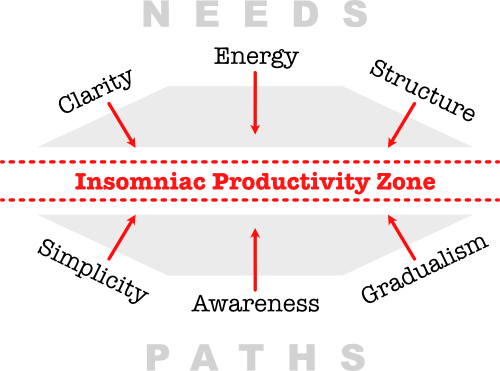
Structure is one of the elements of The Insomniac's Hexagon, appearing at the top under "Needs". It is not an absolute quest for perfect days. It is something quieter, more humane, more necessary.
When sleep is unreliable, time becomes elastic. Mornings blur, afternoons drag, evenings arrive too early or too late. Without structure, this fluidity turns corrosive: decision fatigue increases, self-reproach creeps in, and the day begins to feel like something that happens to you rather than something you inhabit.
Structure is not rigidity. It is relief. It reduces the number of choices required when cognitive resources are already depleted. It externalizes intention so that willpower isn’t responsible for the full load. For the insomniac, structure is our stabilizing frame, absorbing the shock of a bad night without collapsing the day that follows.
Avoid the temptations of too-ambitious scheduling and think instead on reliable anchors: a few fixed points that return each day regardless of sleep quality. These anchors create continuity when rest cannot. They restore a sense of coherence to imperfect days, and make progress possible even when energy is scarce.
Release Day!
Today, I’m pleased to announce the publication of The Insomniac’s Guide to Productivity.
This book grew out of a simple, stubborn fact: some of us don’t sleep well — and waiting for perfect rest before living fully is not an option. Rather than offering another program to “fix” sleep, this guide focuses on practical, humane tools for thinking clearly, choosing wisely, and working meaningfully despite fatigue.
It’s a book about limitation as a starting point, not a flaw; about shaping environments instead of relying on willpower; and about doing fewer things, better.
If you live with insomnia — or any persistent constraint — I hope this guide meets you where you are, and helps you build a productive life despite those challenges.
There are links here on site for purchase, or you can go directly to the ebook, the paperback, or the hardcover. (Don't forget: audiobook coming soon!)
Bathe
Recently I came across a YouTuber who, just as a passing comment, a throwaway, referenced "forest bathing" as pseudoscience or some other kind of idiot fluff, I can't recall just how he put it. He's a very smart guy, in fact, and his subject wasn't health-related (it was music-related), it was just lumped together with a lot of other things like Ouija boards and astrology and alchemy. I don't think he meant anything specific by it. But because I reference the practice in IG2P, it caught my attention straightaway.
Anything — I don't care what it is, it could be anything you care to name — anything that heightens your awareness, that points your attention in a particular way and speaks the language of your specific senses, has the chance to be worthwhile. The danger is in using such activities to make broader claims, especially scientific claims without foundation. I cannot think of anyone who would say without qualification, "Going for a walk is useless to clear your mind" or "Sitting meditation is complete nonsense and a waste of time." Spending time in the forest — which is all "forest bathing" really is — is not useless or a waste of time either, if it speaks to you and your nature. The phrase may sound a bit silly at first, so call it something else that pleases you and opens your understanding to potentials.
"Groves of redwoods and beeches are often compared to the naves of great cathedrals: the silence; the green, filtered, numinous light. A single banyan, each with its multitude of trunks, is like a temple or mosque — a living colonnade. But the metaphor should be the other way around. The cathedrals and mosques emulate the trees. The trees are innately holy." – Colin Tudge, biologist
"What makes Dr. Makino so different from other botanists is that he treats all plants with the same love and affection. Not just wild grasses, trees, and flowers, but vegetables, garden varieties, and invasive species — to him it makes no difference. I try to always have that same loving gaze as a photographer. I am grateful to Dr. Makino for showing me the way." – Ichigo Sugawara, photographer
To sleep, perchance…
In the 2025 Hobonichi Weeks, on the page for the week of February 24th, the quotation is from the actor Rinko Kikuchi, and it's a tip for getting to sleep easily:
Relax, and put your thumb and index finger together. Concentrate all your senses on the surface that is touching. After a while, it will grow warm and you will feel as if the boundary between the two fingers is disappearing. Keep focusing on that vanished boundary, and you will fall asleep before you know it.
Does it work for you? I haven't had much luck with it, but it's not a bad idea!
One Week Away…
Just one week to go, January 21st is the day!
After months (and, fittingly, many late nights), The Insomniac’s Guide to Productivity is just seven days away from publication. What began as a personal attempt to make life workable under less-than-ideal conditions has become something I’m genuinely excited to share.
This book is not about fixing sleep. It’s about facing reality as it is—fragmented rest, imperfect energy, and real obligations—and still finding ways to think clearly, choose wisely, and move forward. The tools inside are practical, humane, and designed for real life, not ideal conditions.
If you’ve ever tried to be productive while tired, foggy, or running on less than you’d like, this book was written with you in mind.
More details soon. For now, I’m counting down the days—and feeling deeply grateful to be this close.
You can pre-order the ebook at this link on Amazon, or bookmark the same page for other formats which will be released on the 21st.
The Power of Choice
Most of us don’t fail to do what matters because we’re lazy or indifferent. We fail because what matters never quite becomes real enough to survive the day.
You decide you want to do X. It feels sincere. Even important. Then the hours pass. The week fills. X slips quietly beneath emails, errands, conversations, and the thousand small demands that arrive uninvited. Eventually you wonder whether you ever truly wanted it at all.
The uncomfortable truth is simpler—and more hopeful: wanting is not the same as prioritizing.
Prioritization isn’t about ambition or motivation. It’s about facing reality without flinching. You are finite. Your time is finite. Your energy—especially if you’re tired or sleep-deprived—is even more so. Every “yes” silently contains a dozen unspoken “no’s,” whether you acknowledge them or not. When those decisions remain unconscious, fantasy takes over. When they’re made deliberately, progress suddenly becomes possible.
What’s surprising is how little equipment this requires. No special apps. No heroic willpower. Just the willingness to pause, look at a calendar, and decide—clearly—what comes next. Not eventually. Not ideally. Now.
There’s a quiet relief that comes with this kind of honesty. The pressure to do everything dissolves. Focus sharpens. The work you choose may be smaller than your imagination hoped for, but it becomes something you actually do. And doing—even a little—changes your relationship to time far more than planning ever could.
For anyone who lives with fatigue, distraction, or an overactive mind, prioritization isn’t a productivity trick. It’s a form of self-respect. A way of saying: this matters enough to choose.
If that idea feels both obvious and strangely difficult, that tension is worth exploring.
Shape Your Space
Most productivity advice assumes one thing above all else: that you are well-rested, well-motivated, and ready to push through resistance by force of will. But what if the problem isn’t your discipline at all? What if the real obstacle is the space you’re standing in?
We tend to think of our environments as neutral backdrops—unchanging, familiar, invisible. That familiarity is comforting, but it’s also deceptive. Over time, rooms, desks, routines, and even the contents of our pockets quietly shape what feels possible. They can either support fragile energy—or drain it before we ever begin.
The idea behind Habitat is simple but unsettling: success often comes not from overcoming resistance, but from designing life so resistance never has a chance to appear. That doesn’t mean dramatic overhauls or aspirational minimalism. It means paying attention to what’s within reach, what’s slightly out of reach, and what follows you when you leave the room.
Sometimes the smallest intervention is enough. A cleared surface. One object given a logical home. A tool placed where the work actually happens. These are not cosmetic changes; they’re psychological ones. Order doesn’t just calm the eye—it calms the nervous system. And calm, for the chronically under-slept, is fuel.
At a slightly wider scale, subtle environmental mismatches begin to matter: a chair that quietly breeds tension, lighting that fatigues focus, colors that stimulate when you need grounding—or lull you when you need clarity. None of this is mystical. It’s experiential. Your body already knows the difference; it just hasn’t been asked.
And then there’s mobility: the overlooked burden of leaving your workspace unprepared. Hunger, dead batteries, missing cables, forgotten notes. Each one is a small tax on cognition, paid when you can least afford it.
Habitat asks a provocative question: instead of asking more from yourself, what if you asked more from the spaces that contain you? Once you start looking, it’s difficult not to see how much of life is shaped—not by effort—but by what’s already in the room.
What is The Insomniac’s Guide to Productivity?
Good Morning! Or afternoon. Or middle of the night. Nice to meet you.
I am an insomniac, and I have been one ever since I can remember, going all the way back to pre-Kindergarten days through an additional half century of more or less constant experience. If you are reading this, there is a fair chance you didn’t sleep well last night, or last week, or perhaps you haven’t slept well for your entire life. The good, “normal” nights, in my experience, stand out in stark and uncommon relief.
Throughout my life—through school, university, marriage, holding 9-to-5 jobs (including both day and night shifts), and two decades as a partner in a business—I have struggled with the challenges of sleeplessness.
The Insomniac's Burden
Despite the constant experience of chronic and sometimes catastrophic insomnia, daily life and work still impose their demands. We are alive with obligations, responsibilities, chores, and duties galore.
Unfortunately, the statistics suggest the situation is not improving; people are not sleeping better, year over year. Insomnia is a broad term covering an unimaginable range of individual cases, but even the lowest estimates are alarming, with at least 70 million adults experiencing insomnia in the US alone. A 2023 RAND study estimated that one-third of the adults in the countries they studied experience at least some symptoms of insomnia. Insomnia and its effects are decidedly on the wrong side of productivity. In fact, the estimated economic impact is staggering, totaling upwards of $200 billion in the US alone, with other major economies also forgoing tens of billions of dollars in lost productivity.
A Toolkit for Sleepless Success
We need to thrive as best we are able. This book, essentially, is a toolbox. Its aim is not the “fixing” of sleep, but the ability to be productive, or more effectively productive, despite insomnia.
We are going to hack some systems—your systems—to find ways that allow you to be productive despite inadequate sleep. Everything is presented as simple, real solutions you can choose from a la carte. We are prioritizing the easy, the effective, and the efficient, along with a healthy dose of benign self-care; there will be no sergeant drills or tough love.
My strategies come from decades of living with insomnia, speaking with friends and strangers, and even participating in a full-blown “sleep study”. While I have read medical literature, I am not a doctor, nor trained in medical practice or procedures of any kind. My contention is that medical expertise is not needed for evaluating improvements in insomnia-related productivity.
Who This Toolkit Is For (And How to Use It)
This book is intended for you if you have been struggling to balance your insomnia with your productive life—anything that veers toward what you would call "chronic". I assume you are already familiar with the common wisdom around fixing your sleep, such as turning off electronics or using a darkened room, and we will not waste time covering those factoids.
We seek action steps, from beginning through to intermediate, always striving for simplicity (on the level of 1-2-3) and incremental improvement.
This is a field manual providing working information to get you through various challenges related to sleep dysfunction. It is structured as an a la carte menu or buffet; you are not meant to do everything in the book. Pick and choose what looks good for you to find new things to try.
However, this toolkit may not be for you if you are a generally well-rested human being. Furthermore, if your work schedule is heavily structured to the point where flexibility and personal decision-making is not a realistic option, I would advise seeking professional, medical-grade help. Being in charge of your time options is the best-case scenario for improving insomniac productivity.